

Košík.cz as the first CEE grocery retailer on the ChatGPT Marketplace
Czech online grocery leader Košík.cz is now live on the ChatGPT App Marketplace — the first e-grocery retailer in Central & Eastern Europe to offer a fully transactional AI agent. Customers describe what they need in plain language, and the AI handles the rest. No browsing, no clicking, no category menus. Just a conversation.

.avif)
"We weren't interested in building another chatbot that just talks about food. The breakthrough is giving the agent hands — letting it reach into our warehouse, see real prices in real time, and actually reserve products for the customer."

The problem with online grocery shopping
Online grocery shopping solved logistics — but the shopping experience itself hasn't fundamentally changed. Customers still browse categories, scroll product lists, and manually build their carts. It works, but it's slow, repetitive, and uninspiring — especially for the routine weekly restocking that most households do.
Košík.cz decided to challenge that. Rather than building another recommendation chatbot that suggests recipes and sends customers back to the website, they wanted something transactional — an AI agent that actually completes the purchase.
That's where we came in. Košík.cz brought the vision, the commerce infrastructure, and the deep product knowledge. We brought the AI architecture, the MCP implementation, and the integration layer that connects it all to ChatGPT.
What the agent does
The Košík Shopping MCP connects ChatGPT directly to the Košík.cz e-commerce infrastructure. From the customer's perspective, the entire shopping trip happens in a single conversation. Under the hood, the system executes five distinct steps:
1) Understand intent
AI interprets natural language into structured shopping context. "I'm making Thai curry for five, pick what's on sale" becomes a precise product query.
2) Search and match products
Queries the full Košík.cz catalog — 4× the range of a typical supermarket — compares options, and selects the best fit.
3) Assemble the cart
Adds items, handles quantities, presents a complete summary for the customer's review and approval.
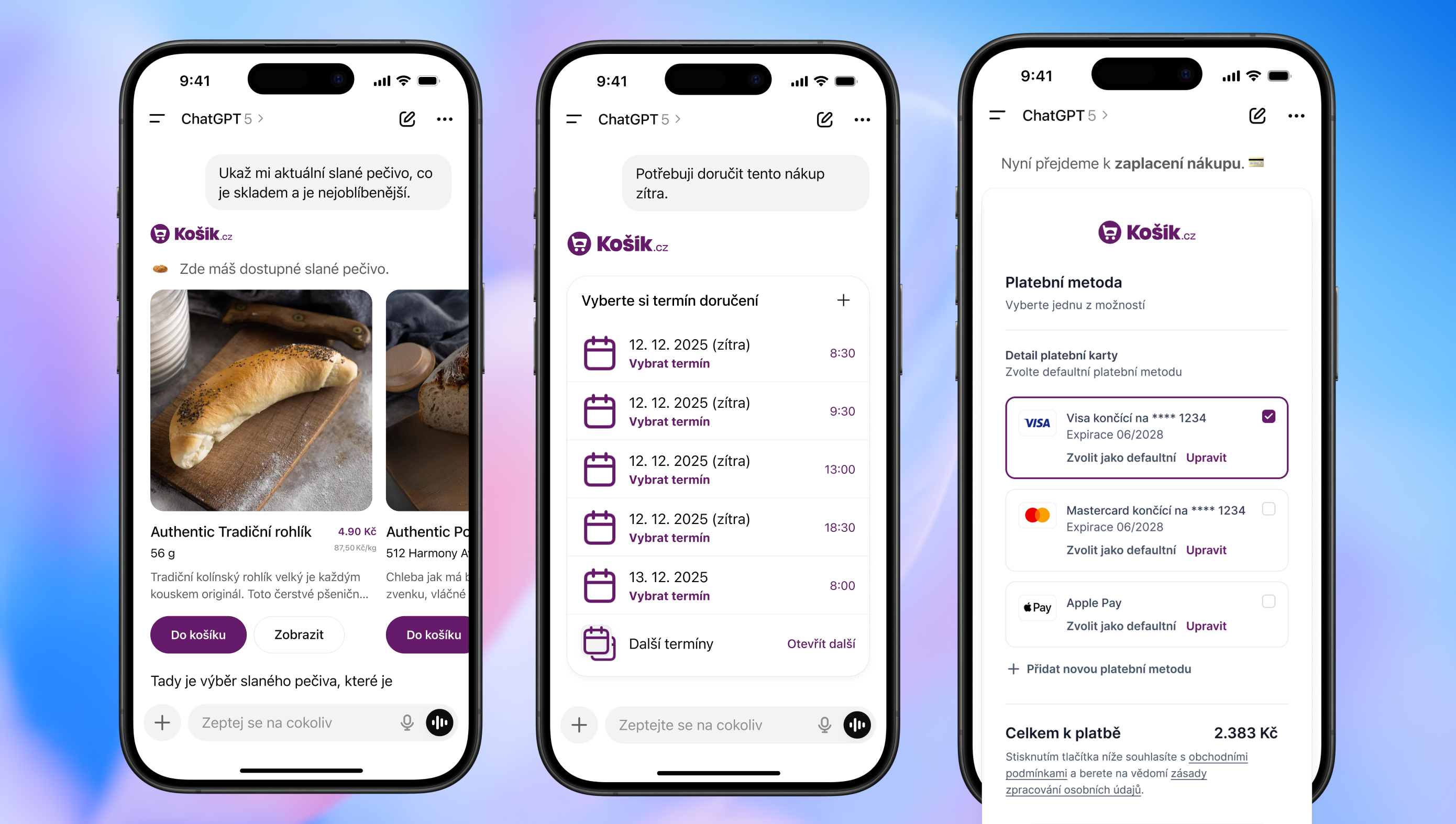
4) Configure delivery and payment
Sets address, picks an available delivery window, applies the customer's preferred payment method.
5) Execute the order
Confirms the transaction, triggers fulfillment — all without the customer ever leaving the conversation.
The hard part: teaching AI to understand groceries
The most technically challenging aspect wasn't connecting to ChatGPT — it was building the semantic layer that makes the agent genuinely useful.
A grocery catalog isn't like a bookstore. Prices and stock levels change every minute. A customer who says "something for breakfast for the kids" doesn't want a beer promotion — they want cereals, yogurts, and fruit. Getting that right required a deep semantic mapping of the entire product catalog, designed so the AI model understands relationships between products, categories, and real human intent.
"The AI is actually better at searching our catalog than traditional full-text search. Because it understands context — it understands what you mean, not just what you type. Jan Kopecký, Product Director at Košík.cz"
Real-time data accuracy was equally critical. In food e-commerce, latency kills trust — the agent can't promise a product that's out of stock by the time the customer reaches checkout. The data pipeline had to ensure every response reflects real-time inventory and pricing.
How we built it
The solution is built on the Model Context Protocol (MCP) — an open standard for connecting AI models to external tools and data sources. We chose MCP deliberately over a closed proprietary integration, keeping the architecture open for future expansion to other AI platforms and agent ecosystems.
BigHub
- Designed the overall architecture
- Implemented the MCP server
- Built authentication layer mirroring Košík.cz's existing auth
- Developed UI widget components using ChatGPT Apps SDK
- Delivered deployable Docker containers
Košík.cz
- Provided API access and documentation
- Defined shopping flow and business logic
- Handled transaction and payment layer
- Deployed on their Kubernetes cluster
- Owns the customer relationship and support
The project took approximately 3–6 months from kickoff to launch — reflecting both the technical complexity of real-time grocery integration and the care required to get the semantic layer right.
The bigger picture: from chatbots to agentic commerce
Košík.cz does not see this launch as the addition of a new feature, but rather as a shift in sales channels. According to Jan Kopecký’s prediction, within the next few years, approximately 10% of all Košík.cz orders will be placed through AI agents. By 2030, this share could grow to as much as 25%.
The logic is simple: grocery shopping is a utility, not a pleasure. Most people don't enjoy restocking the same items every week. Once customers experience the convenience of saying "restock what I had last time and add something for weekend grilling," the return to manual browsing becomes unlikely.
And this is just the beginning. The next phase is what Kopecký calls "agent-to-agent commerce" — where a customer's personal AI assistant communicates directly with Košík's commerce agent. Your phone knows you have dinner guests on Tuesday, knows about their allergies, checks what's in your fridge, negotiates the best prices, books a delivery slot, and sends you one notification: "Tuesday dinner shopping done. Delivery at 5 PM. Confirm?"
"The barrier to entry is constantly decreasing, but the head start you gain by working through the mistakes now is irreplaceable. AI agents are the sharpest tool we have for removing friction from the customer journey, says Jan in Synthetic Minds podcast by BigHub."
The full story — in conversation with Jan Kopecký
In our BigHub Synthetic Minds podcast episode, Jan Kopecký goes deeper into how Košík.cz is preparing for a future where agents order from agents. He explains why the traditional e-shop will stop being the primary purchase channel, how AI is transforming work inside the company, and why retailers who wait are falling behind.
News from the world of BigHub and AI
We’ve packed valuable insights into articles — don’t miss out.
Why AI coding tools and new libraries should not run directly on your Mac
When people discuss security around vibe coding tools today, it often sounds as if this were a completely new problem. In reality, it is not new at all. Over the past few years, we have simply become used to running third-party code, third-party dependencies, and increasingly also third-party shell commands directly on our local machines — the same machines where we keep SSH keys, .env files, logged-in browsers, cloud access, and often even production credentials.
AI tooling did not create this problem. It only amplified it and made it much more visible.
On macOS, I think this is particularly obvious. Many people do not want to develop in Docker because the developer experience quickly deteriorates and containers on Mac still come with overhead. So the real default remains the same: everything runs on the host machine, and we hope nothing happens.
This works exactly until it does not.
LiteLLM only reminded us of an old problem
On March 24, 2026, compromised versions of litellm 1.82.7 and 1.82.8 appeared on PyPI. This was not an exotic exploit. A simple pip install was enough to introduce a malicious .pth file into the environment, which then executed when Python started.
It then reached for the kind of things that are typically easy to find on a developer machine:
- SSH keys
.envfiles- cloud credentials
- other secrets and configuration files
It then sent them to a remote server.
The important thing about this incident is how banal the attack path was. It did not need to break Python, bypass the kernel, or convince someone to run anything unusual. It only needed a developer to do what developers do every day: install a dependency.
Paradoxically, the whole thing may have been discovered faster because the malware was not written very well and triggered a fork bomb on some machines. If it had kept a lower profile and only exfiltrated data silently, it is quite possible that it would have remained unnoticed for longer.
In my view, a large share of regular developers would have been vulnerable to this — not only people experimenting with vibe coding. The reason is simple: very few people have their local Python environment truly isolated.
The JavaScript world was not doing much better either
This is not only a Python story.
On March 30 and 31, 2026, axios — one of the most widely used libraries in the JavaScript world — was also compromised. The attacker took over a maintainer account on npm and published malicious versions axios@1.14.1 and axios@0.30.4.
What is interesting is that the malicious payload was not directly inside axios itself. Those versions only added a new transitive dependency, plain-crypto-js, which executed through a postinstall hook. In other words, even here, an ordinary install was enough to turn the dependency chain into an execution chain.
That is exactly why I find it dangerous to pretend that supply-chain risk only applies to dubious packages at the edge of the ecosystem. It does not. Last week, this became visible in one of the most common HTTP clients for Node.js.
exclude-newer is a reasonable default
One of the few low-cost guardrails that makes sense for almost everyone is not installing completely fresh package releases immediately.
In uv, you can use exclude-newer, which limits dependency resolution to packages published before a selected date:
[tool.uv]
exclude-newer = "2026-03-24"
This is not a magic defense. It only buys you time. If you keep, for example, a 14-day delay, there is a reasonable chance that a compromised release will be discovered during that time and either removed or at least flagged by the community.
The same logic applies to AI coding tools
Just as you do not want to blindly run fresh dependencies on the host machine, you also do not want to run a code generator on the host machine with full access to everything around it.
This is not an argument against Codex, Claude Code, or any other tool. It is an argument against the amount of trust we give these tools by default.
Lightweight sandboxes are a good start. Codex CLI on macOS has historically used sandbox-exec, which can significantly limit where a process is allowed to reach. In Claude Code, sandboxing can be enabled via /sandbox. In both cases, this is significantly better than a mode where the agent can see the whole disk and run shell commands without restrictions.
This has two practical advantages:
- the agent typically sees only the repository or explicitly allowed paths
- you do not need to approve every small action just to maintain at least some control surface
For regular reading, file editing, and part of shell work, this is actually a useful middle ground.
Where this model hits its limits
The problem is that a lightweight sandbox is not the same as real isolation.
As soon as the tool needs to do something slightly more practical, the edges start to show:
- package installation through
uv,pip,npm, or similar tools often touches global caches - browser tooling may not work well inside the sandbox, or may not work at all
- some MCP servers need access outside the repository boundary
- sooner or later, you run into a command that simply has to be executed outside the sandbox
And at that moment, the vibe coder is asked whether the system can leave the sandbox — and most people simply click “Yes”.
That is why I think it is important not to confuse “it has some sandbox mode” with “it is safely isolated”.
What I think makes more sense
If we want to use agents or code generators seriously, we need a real sandbox. Ideally, a separate VM or microVM for each project. On Mac, this could be something like Lima or a similar VM-based solution. Docker sandboxes follow a similar direction in principle, although on macOS they often run into performance and developer-experience issues.
But the point is not the specific product. The point is the trust boundary.
Into such an environment, you move only what the specific project actually needs:
- repository checkout
- project-scoped credentials
- local cache dedicated only to that project
- optionally a browser session or MCP servers, but again only where it makes sense
This reduces the blast radius twice.
First: if the agent runs a destructive command such as rm -rf /, it destroys at most its own sandbox.
Second: if you install a compromised dependency such as an infected litellm, it cannot exfiltrate all credentials from the entire laptop. At worst, it gets access to what you placed into that specific environment. Ideally, that means only development secrets for one project.
That is still not a pleasant incident. But it is an order of magnitude better incident.
A classifier is useful, but it is not a sandbox
Claude Code has now also added an auto mode, where another classifier runs over more sensitive actions. It evaluates the transcript and individual tool calls, especially Bash commands and other actions outside the repository, and tries to block things such as data exfiltration, credential hunting, or destructive actions outside the scope of the task.
That is a reasonable step forward. Approval fatigue is real, and manually confirming everything is not a very sustainable model.
But even here, I think it is important to keep the right expectation: a classifier is a guardrail, not isolation.
It also does not solve the supply-chain problem. If you install a malicious package inside a trusted environment, a classifier watching Bash commands will not help you against what that package does during import or interpreter startup.
What I would take from this as a practical default
My current take is simple:
- do not run completely fresh dependencies without a delay
- do not run AI coding tools directly on the host machine with full access
- when using a lightweight sandbox, do not treat it as the final solution
- for more important work, use a per-project isolated environment with a limited blast radius
All of this was true long before someone came up with the term vibe coding.
There is just much less room to avoid it now. When you give an agent shell access, filesystem access, browser access, and credentials, you are effectively giving it very strong permissions. And as the LiteLLM incident showed, a regular package manager receives similarly strong permissions the moment you allow it to install third-party code directly on your laptop without isolation.
This is not a niche security debate. It is a fairly basic engineering default that we should have had in place a long time ago.
Apple is currently working on a new container engine, which I hope will have a lot of this built in. Until then, I try to pay close attention whenever commands are executed outside the sandbox.
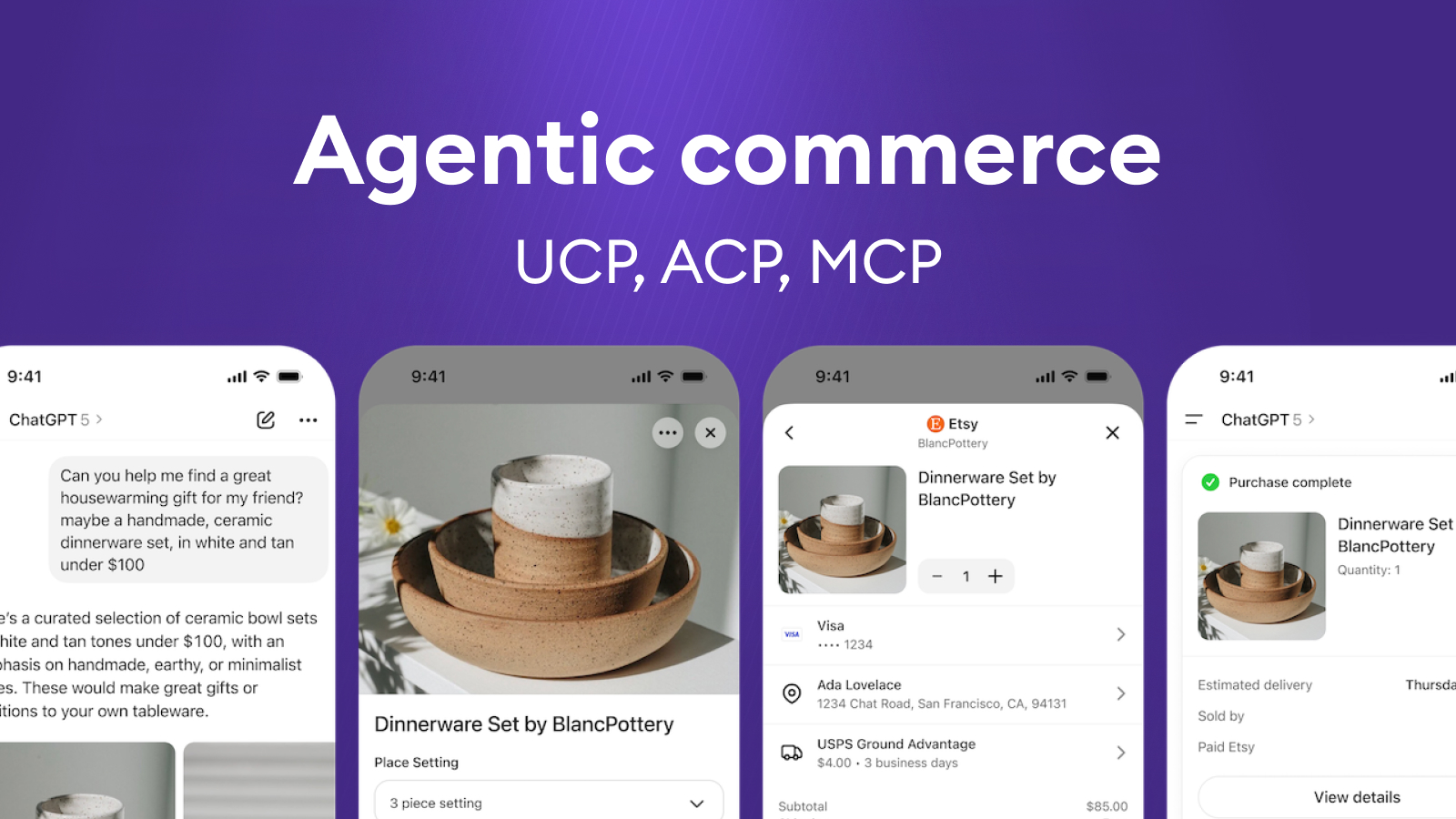
UCP, ACP, MCP in Agentic Commerce: AI is moving from “recommending” to “doing”
Where are we now
Over the last few months, several important things have happened in AI and e-commerce:
- Google introduced UCP (Universal Commerce Protocol) – an open standard for agentic commerce that unifies how an AI agent talks to a merchant: catalogue, cart, shipping, payment, order.
- OpenAI and Stripe launched ACP (Agentic Commerce Protocol) – a protocol for agentic checkout in the ChatGPT ecosystem.
- At the same time, MCP (Model Context Protocol) has emerged as a general way for agents to call tools and services, and OpenAI Apps SDK as a product/distribution layer for agent apps.
In other words, the internet is starting to define standardised “rails” for how AI agents will shop. And the market is shifting from “AI recommends” to “AI actually executes the transaction”.
In this article, we look at:
- what agentic commerce means in practice,
- how UCP, MCP, Apps SDK and ACP fit together,
- what these standards solve – and what they very intentionally don’t solve,
- and where custom agentic commerce makes sense – the exact type of work we do at BigHub.
What Is Agentic commerce
Agentic commerce is a shopping flow where an AI agent handles part or all of the process on behalf of a person or a business – from discovery and comparison to payment.
A typical scenario:
“Find me marathon running shoes under $150 that can be delivered within two weeks.”
The agent then:
- understands the request,
- queries multiple merchants,
- compares parameters, reviews, prices and delivery options,
- builds a shortlist,
- and, once the user approves, completes the purchase – ideally without the user ever touching a traditional web checkout.
This doesn’t only apply to B2C. Similar patterns show up in:
- internal procurement,
- B2B ordering,
- recurring replenishment,
- service and returns flows.
The direction is clear, AI is moving from “help me choose” to “get it done for me”.
MCP, Apps SDK, UCP and ACP
It’s useful to see today’s stack as layers.
MCP (Model Context Protocol) is:
- a general standard for how an agent calls tools, APIs and services,
- domain-agnostic (“I can talk to CRM, pricing, catalogue, ERP, …”),
- effectively the way the agent “sees” the world – through capabilities it can invoke.
In short: MCP = how the agent reaches into your systems.
OpenAI Apps SDK:
- provides UI, runtime and distribution for agents (ChatGPT Apps, user-facing interface),
- lets you quickly wrap an agent into a usable product:
- chat, forms, actions,
- distribution inside the ChatGPT ecosystem,
- basic management and execution.
In short: Apps SDK = how you turn an agent into a product people actually use.
UCP – Domain standard for commerce workflows
UCP (Universal Commerce Protocol) from Google and partners:
- is a domain-specific standard for commerce,
- unifies how an agent talks to a merchant about:
- catalogue, variants, prices,
- cart, shipping, payment, order,
- discounts, loyalty, refunds, tracking and support,
- is designed to work across Google Search, Gemini and other AI surfaces.
In short: UCP = the concrete language and workflow of buying.
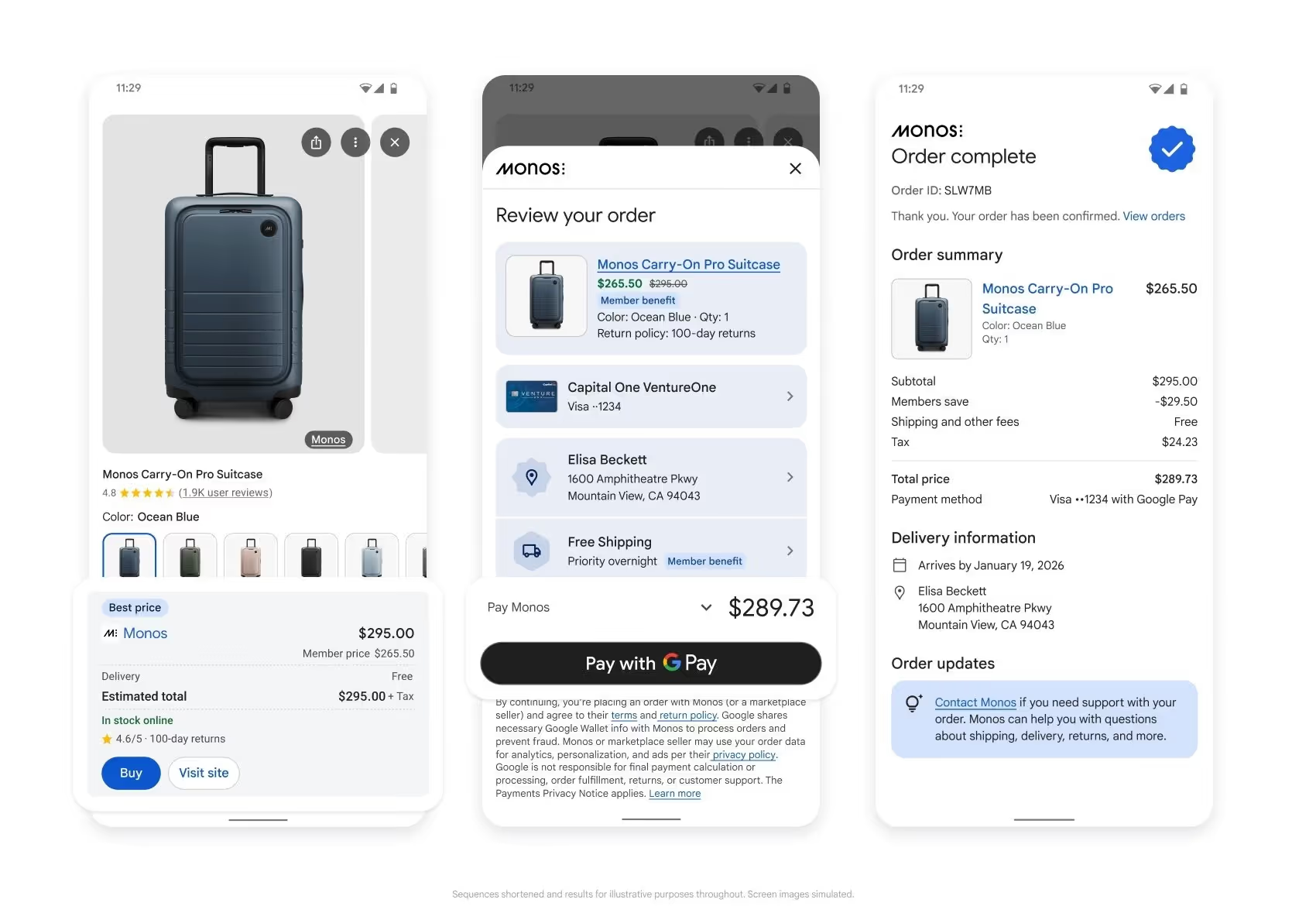
ACP – Agentic checkout in the ChatGPT ecosystem
ACP (Agentic Commerce Protocol) from OpenAI/Stripe:
- targets a similar domain from the ChatGPT side,
- focuses strongly on checkout, payments and orders,
- powers features like Instant Checkout in ChatGPT.
From a merchant’s point of view, UCP and ACP are competing commerce standards (no one wants three different protocols in their stack).
From an architecture point of view, they can coexist as different dialects an agent uses depending on the channel (ChatGPT vs. Google / Gemini).

What these standards do – and what they don’t
The common pattern is important. UCP and ACP do not make agents “smart”. They just give them a consistent language.
These standards typically cover:
- how the agent formally communicates with the merchant and checkout,
- how offers and orders are structured,
- how payment and authorisation are handled securely,
- how a purchase can flow across different AI channels.
They do not (and cannot) solve:
- the quality and structure of your product catalogue, attributes and availability,
- integration into ERP, WMS/OMS, CRM, loyalty, pricing engine, campaign tooling,
- your business logic – margin vs. SLA vs. customer experience vs. revenue,
- governance, risk, approvals – who is allowed to order what, when a human must step in, how decisions are audited.
Practically, this means:
- you can be formally “UCP/ACP-ready”,
- and still deliver a poor agent experience if:
- data is inconsistent,
- delivery promises can’t be kept,
- pricing and promo logic breaks in a multi-channel world,
- the agent has no access to real-time states and internal rules.
The standard is a necessary technical minimum, not a finished solution.
How we approach Agentic Commerce at BigHub
At BigHub, we see UCP, MCP, ACP and Apps SDK as infrastructure building blocks. On real projects, we focus on what creates actual competitive advantage on top of them.
We build ML-powered commerce agents that can:
- optimise dynamic offers and pricing (bundles, alternatives, smart trade-offs based on margin, SLA and priorities),
- deliver personalised search and shortlists (customer context, preferences, budget, interaction history),
- handle argumentation and objections (why this option, what are the alternatives, explain the trade-offs),
- and only then smoothly push the checkout over the finish line.
On top of that, we add an integration layer via MCP (capabilities + connections to core systems). For UI and distribution, we often use OpenAI Apps SDK when we need to get an agent in front of real users quickly. Where it makes sense, we plug into standards like UCP/ACP instead of writing bespoke integrations for every single channel.
Where custom Agentic Commerce makes the difference
Standards (UCP/ACP/MCP) are extremely valuable where:
- you don’t want to invent your own protocol for connecting to AI channels,
- you need interoperability (ChatGPT, Google/Gemini, others),
- you want to reduce integration overhead for merchants.
A custom approach adds the most value in these areas:
1) Connecting the agent to core systems
- ERP, WMS/OMS, CRM, loyalty, pricing, returns, contact centre…
- the agent must live in your real operational architecture, not a demo sandbox.
Typically you need a dedicated integration and orchestration layer that:
- speaks UCP/ACP/MCP “upwards”,
- speaks your specific systems and APIs “downwards”.
2) Domain logic and business Rules
This is where competitive advantage is created:
- when the agent can execute autonomously vs. when it should only recommend,
- how it balances margin, SLA, availability, customer experience and revenue,
- how it works with promotions, loyalty, cross-sell / up-sell scenarios.
This is not a protocol question. It’s about concrete rules on top of your data and KPIs.
3) Multi-channel and the mix of B2C / B2B / Internal agents
Real-world commerce looks like this:
- B2C webshop,
- B2B ordering portal,
- internal purchasing agent,
- in-store sales assistant,
- customer service agent.
A custom framework lets you:
- share logic across roles and channels,
- respect permissions and limits,
- support flows like “AI starts in chat, finishes in the store”.
4) European context: Regulation, security, Data residency
For European companies, several constraints matter:
- regulation (EU AI Act, GDPR, sector-specific rules),
- internal security posture, audits, risk controls,
- where data and models actually run (US vs. EU),
- how explainable and auditable agent decisions are.
Standards are global, but architecture and governance have to be local and tailored.
What retailers and enterprises should take away from UCP (and other similar protocols)
If you’re thinking about agentic commerce, it’s worth asking a few practical questions:
- Are we “agent-ready” not only at the protocol level, but also in terms of data and processes?
- In which use cases do we actually want the agent to execute the transaction – and where should it stay at the recommendation level?
- How will agentic commerce fit into our existing systems, pricing, campaigns and SLAs?
- Who owns agent initiatives internally (KPI, P&L) and how will we measure success?
- Which parts make sense to solve via standards (UCP/ACP/MCP) and where do we already need a custom agent framework?
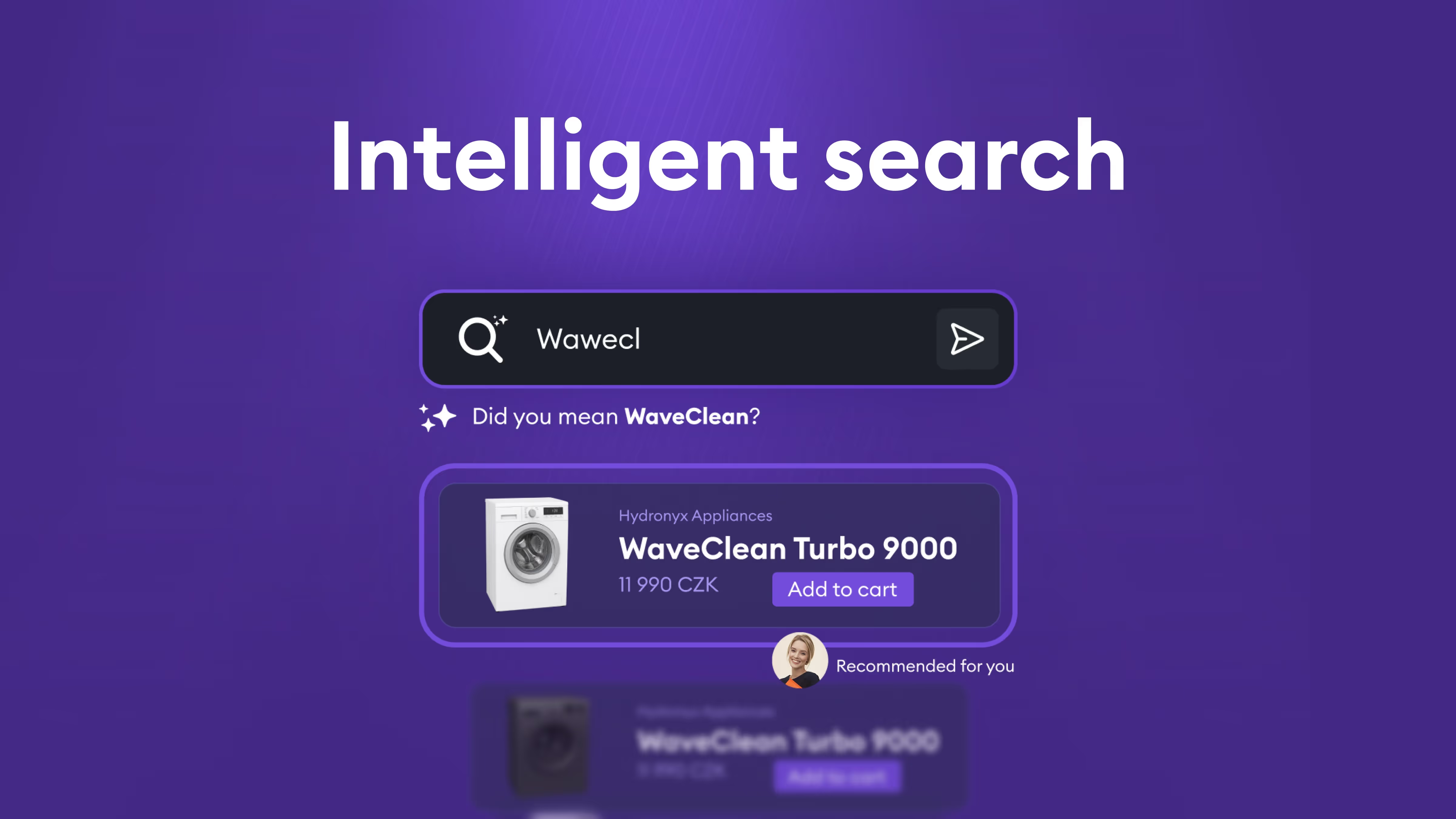
How to build intelligent search: From full-text to optimized hybrid search
The problem: Limits of traditional search
Classic full-text search based on algorithms like BM25 has several fundamental constraints:
1. Typos and variants
- Users frequently submit queries with typos or alternate spellings.
- Traditional search expects exact or near-exact text matches.
2. Title-only searching
- Full-text search often targets specific fields (e.g., product or entity name).
- If relevant information lives in a description or related entities, the system may miss it.
3. Missing semantic understanding
- The system doesn’t understand synonyms or related concepts.
- A query for “car” won’t find “automobile” or “vehicle,” even though they are the same concept.
- Cross-lingual search is nearly impossible—a Czech query won’t retrieve English results.
4. Contextual search
- Users often search by context, not exact names.
- For example, “products by manufacturer X” should return all relevant products, even if the manufacturer name isn’t explicitly in the query.
The solution: Hybrid search with embeddings
The remedy is to combine two approaches: traditional full-text search (BM25) and vector embeddings for semantic search.
Vector embeddings for semantic understanding
Vector embeddings map text into a multi-dimensional space where semantically similar meanings sit close together. This enables:
- Meaning-based retrieval: A query like “notebook” can match “laptop,” “portable computer,” or related concepts.
- Cross-lingual search: A Czech query can find English results if they share meaning.
- Contextual search: The system captures relationships between entities and concepts.
- Whole-content search: Embeddings can represent the entire document, not just the title.
Why embeddings alone are not enough
Embeddings are powerful, but not sufficient on their own:
- Typos: Small character changes can produce very different embeddings.
- Exact matches: Sometimes we need precise string matching, where full-text excels.
- Performance: Vector search can be slower than optimized full-text indexes.
A hybrid approach: BM25 + HNSW
The ideal solution blends both:
- BM25 (Best Matching 25): A classic full-text algorithm that excels at exact matches and handling typos.
- HNSW (Hierarchical Navigable Small World): An efficient nearest-neighbor algorithm for fast vector search.
Combining them yields the best of both worlds: the precision of full-text for exact matches and the semantic understanding of embeddings for contextual queries.
The challenge: Getting the ranking right
Finding relevant candidates is only step one. Equally important is ranking them well. Users typically click the first few results; poor ordering undermines usefulness.
Why simple “Sort by” is not enough
Sorting by a single criterion (e.g., date) fails because multiple factors matter simultaneously:
- Relevance: How well the result matches the query (from both full-text and vector signals).
- Business value: Items with higher margin may deserve a boost.
- Freshness: Newer items are often more relevant.
- Popularity: Frequently chosen items may be more interesting to users
Scoring functions: Combining multiple signals
Instead of a simple sort, you need a composite scoring system that blends:
- Full-text score: How well BM25 matches the query.
- Vector distance: Semantic similarity from embeddings.
- Scoring functions, such as:
- Magnitude functions for margin/popularity (higher value → higher score).
- Freshness functions for time (newer → higher score).
- Other business metrics as needed.
The final score is a weighted combination of these signals. The hard part is that the right weights are not obvious—you must find them experimentally.
Hyperparameter search: Finding optimal weights
Tuning weights for full-text, vector embeddings, and scoring functions is critical to result quality. We use hyperparameter search to do this systematically.
Building a test dataset
A good test set is the foundation of successful hyperparameter search. We assemble a corpus of queries where we know the ideal outcomes:
- Reference results: For each test query, a list of expected results in the right order.
- Annotations: Each result labeled relevant/non-relevant, optionally with priority.
- Representative coverage: Include diverse query types (exact matches, synonyms, typos, contextual queries).
Metrics for quality evaluation
To objectively judge quality, we compare actual results to references using standard metrics:
1. Recall (completeness)
- Do results include everything they should?
- Are all relevant items present?
2. Ranking quality (ordering)
- Are results in the correct order?
- Are the most relevant results at the top?
Common metrics include NDCG (Normalized Discounted Cumulative Gain), which captures both completeness and ordering. Other useful metrics are Precision@K (how many relevant items in the top K positions) and MRR (Mean Reciprocal Rank), which measures the position of the first relevant result.
Iterative optimization
Hyperparameter search proceeds iteratively:
- Set initial weights: Start with sensible defaults.
- Test combinations: Systematically vary:
- Field weights for full-text (e.g., product title vs. description).
- Weights for vector fields (embeddings from different document parts).
- Boosts for scoring functions (margin, recency, popularity).
- Aggregation functions (how to combine scoring functions).
- Evaluate: Run the test dataset for each combination and compute metrics.
- Select the best: Choose the parameter set with the strongest metrics.
- Refine: Narrow around the best region and repeat as needed.
This can be time-consuming, but it’s essential for optimal results. Automation lets you test hundreds or thousands of combinations to find the best.
Monitoring and continuous improvement
Even after tuning, ongoing monitoring and iteration are crucial.
Tracking user behavior
A key signal is whether users click the results they’re shown. If they skip the first result and click the third or fourth, your ranking likely needs work.
Track:
- CTR (Click-through rate): How often users click.
- Click position: Which rank gets the click (ideally the top results).
- No-click queries: Queries with zero clicks may indicate poor results.
Analyzing problem cases
When you find queries where users avoid the top results:
- Log these cases: Save the query, returned results, and the clicked position.
- Diagnose: Why did the system rank poorly? Missing relevant items? Wrong ordering?
- Augment the test set: Add these cases to your evaluation corpus.
- Adjust weights/rules: Update weights or introduce new heuristics as needed.
This iterative loop ensures the system keeps improving and adapts to real user behavior.
Implementing on Azure: AI search and OpenAI embeddings
All of the above can be implemented effectively with Microsoft Azure.
Azure AI Search
Azure AI Search (formerly Azure Cognitive Search) provides:
- Hybrid search: Native support for combining full-text (BM25) and vector search.
- HNSW indexes: An efficient HNSW implementation for vector retrieval.
- Scoring profiles: A flexible framework for custom scoring functions.
- Text weights: Per-field weighting for full-text.
- Vector weights: Per-field weighting for vector embeddings.
Scoring profiles can combine:
- Magnitude scoring for numeric values (margin, popularity).
- Freshness scoring for temporal values (created/updated dates).
- Text weights for full-text fields.
- Vector weights for embedding fields.
- Aggregation functions to blend multiple scoring signals.
OpenAI embeddings
For embeddings, we use OpenAI models such as text-embedding-3-large:
- High-quality embeddings: Strong multilingual performance, including Czech.
- Consistent API: Straightforward integration with Azure AI Search.
- Scalability: Handles high request volumes.
Multilingual capability makes these embeddings particularly suitable for Czech and other smaller languages.
Integration
Azure AI Search can directly use OpenAI embeddings as a vectorizer, simplifying integration. Define vector fields in the index that automatically use OpenAI to generate embeddings during document indexing.
Get your first consultation free
Want to discuss the details with us? Fill out the short form below. We’ll get in touch shortly to schedule your free, no-obligation consultation.